These days many projects are delivered using Agile methodologies. Agile frameworks focus on flexibility and enable teams to deliver value quickly while adapting to changing business needs. After an MVP is built, a product is often continuously improved through iterative releases until it reaches the desired level of maturity or achieves its business objectives.
At the same time, Agile has become one of the most widely adopted approaches to software delivery, and organisations often interpret and implement it in different ways. In some environments, teams run continuous sprint cycles without regularly delivering meaningful software increments to end users. When this happens, significant effort may be invested in planning, reviews, and testing activities without generating the expected business value. As with any methodology, the effectiveness of Agile depends not only on the framework itself but also on how it is applied in practice.
The situation is similar when it comes to requirements documentation. A common view within the industry is that requirements in Agile environments should primarily be documented as user stories. While user stories are undoubtedly valuable, treating them as the only available technique can overlook the broader range of business analysis approaches that may be appropriate depending on the context and complexity of the work.
User Stories
What makes user stories so popular, and why are they widely used in Agile environments? Let's look at some of their strengths. According to BABOK, user stories:
- Are easily understandable by stakeholders
- Can be developed through a variety of elicitation techniques
- Focus on delivering value to stakeholders
- Encourage collaboration and shared understanding of the business domain
- Support rapid delivery and frequent customer feedback through small, implementable increments
These advantages make user stories particularly effective in environments where collaboration, adaptability, and iterative delivery are key priorities.
However, user stories also have limitations. BABOK notes that user stories are intended primarily as a tool for short-term capture and prioritisation of requirements rather than long-term knowledge retention or detailed analysis. When used in isolation, several challenges may arise:
- Teams may need to invest additional effort in conversations and discovery because detailed specifications are not available upfront
- Teams can lose visibility of the broader business context if stories are not supported by higher-level analysis or visual artefacts
- Additional documentation may still be required to satisfy governance, compliance, future maintenance, or stakeholder expectations
As with any technique, user stories are not a universal solution. In many situations, they work best when complemented by other forms of documentation that provide additional context, detail, or structure.
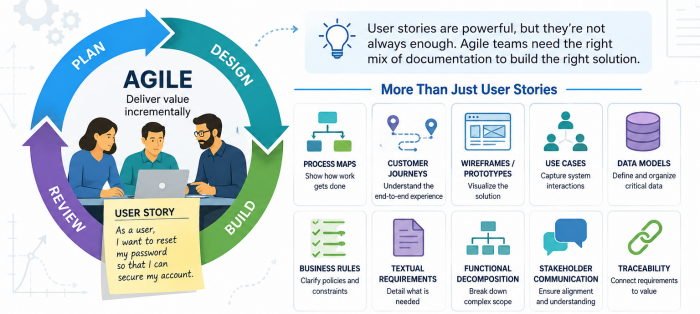
Depending on the project or business need, a business analyst may choose to supplement or, in some cases, replace user stories with other documentation techniques. Examples include:
- Process maps for process-heavy products
- Customer journeys for customer-centric products
- Wireframes or screen mock-ups for user-facing products
- Use cases to describe interactions from the user's perspective
- Data models to capture information structures and relationships
- Textual requirements to document logic and business rules
- Functional decomposition to break down system capabilities
There are many requirements documentation techniques available to business analysts, and user stories represent only one of them.
In my own experience, I have successfully delivered projects using a combination of wireframes, process maps, and detailed textual requirements without relying heavily on user stories. In some cases, requirements were documented primarily through wireframes, while user stories were used only where additional context or clarification was required. This approach helped avoid unnecessary duplication across documentation artefacts while still providing sufficient detail for delivery teams.
User stories can be particularly valuable when requirements are initially provided by business stakeholders or end users, as they are relatively simple and accessible for almost anyone to write and understand. The product team can then further elaborate, analyse, refine, and design the required functionality based on those stories.
It is also important to recognise that a single user story can sometimes represent a highly complex piece of functionality and may eventually evolve into a standalone initiative or even an independent project. In such cases, relying exclusively on user stories may not always provide enough structure or detail. Combining multiple documentation techniques can often provide greater clarity and facilitate more effective communication across teams.
Comprehensive Design
In the real world, before a house is built, architects and builders prepare a comprehensive design that covers multiple aspects of the future property, including the façade, floor plan, site placement, plumbing, and electrical layouts. This provides a complete view of the house from different perspectives and helps ensure that all elements are properly considered before construction begins.
Similarly, a business analyst can use a variety of techniques to create a comprehensive, multidimensional view of a product or feature. Different artefacts may describe the user interface, user experience, business processes, data structures, integrations, and business rules. Together, these provide a holistic understanding of the solution and help minimise ambiguity.
While Agile promotes lightweight documentation, delivery teams often still require an appropriate level of detail to confidently build, test, and maintain solutions. Documentation also provides long-term value by preserving knowledge beyond the life of a project. Future teams responsible for maintaining or enhancing the product can benefit significantly from having access to well-structured documentation and design artefacts.
From a delivery perspective, this approach remains fully compatible with Agile practices. Requirements documented through various techniques can still be broken down into smaller functions, sub-functions, or scenarios that can be prioritised, estimated, and delivered incrementally. Delivery tickets can be linked to the relevant design and requirements artefacts, ensuring traceability while maintaining flexibility.
Conclusion
As Agile delivery methodologies continue to gain adoption, many organisations have come to rely heavily on user stories as their primary requirements artefact. While user stories can be highly effective in many situations, they represent only one of several techniques available to business analysts and product teams.
Successful product design often benefits from a combination of approaches such as wireframes, process maps, business rules, prototypes, data models, and detailed functional requirements. The most appropriate technique depends on factors such as problem complexity, stakeholder needs, team maturity, regulatory requirements, and product characteristics. The delivery methodology itself should not dictate how requirements are documented.
Agile was designed to encourage flexibility, collaboration, and continuous improvement. Those same principles can be applied to requirements and design documentation by selecting the techniques that best support understanding, communication, and delivery outcomes.
An artist does not necessarily need an expensive set of brushes to create a masterpiece and may produce remarkable work using nothing more than a piece of charcoal. In the same way, a skilled business analyst can design and communicate effective solutions using a variety of techniques depending on the specific context and objectives of the project. The true value lies not in following a framework rigidly, but in selecting the right tools and methods to achieve clarity, alignment, and successful delivery.
Author: Dim Zakharov
Dim Zakharov is an expert in business analysis and has extensive experience in process improvements, service design, product management, business architecture and IT projects delivery. Dim has been working on business and digital transformation projects within complex government and commercial environments delivering integrated solutions end to end in various business domains.