INTRODUCTION
Strategy almost never fails on paper. Most leadership teams have defined goals, whether they are about growth, digital transformation, or making operations more efficient. But what really happens in companies is frequently different. Plans become stuck, projected advantages don't happen, and implementation goes off course. This tendency is being supported by more research. The problem isn't coming up with a plan; it's being able to turn that strategy into consistent, value-driven action HBR. The problem is mostly structural. Strategy is described in general, directive terms, but execution needs a clear scope, clear priorities, and demonstrable results. As projects go through different parts of the organization, they are understood in different ways. Functions align work with their own views, ignore dependencies, and start to have different priorities. Over time, this leads to fragmentation, where projects may do well on their own but not provide the business value they were meant to. PMI says that businesses lose more than 11% of their investment because of poor project performance . This is typically because goals are not defined and alignment is weak.
Business analysis operates within this gap, providing the discipline required to connect intent with delivery. Its value lies not in documentation, but in ensuring continuity translating strategy into actionable work while maintaining alignment as execution evolves.
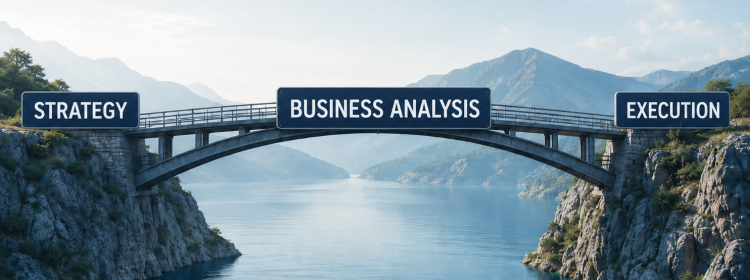
Translating and Aligning Strategy into Execution
One of the most important things that business analysis does is transform vague strategic goals into organized, doable plans. Strategy tells you “What," but not very frequently "how." Business analysts break these goals into capabilities, procedures, and changes that teams can deliver over a period. This translation ensures that execution is grounded and everyone has a shared understanding of value, not a different interpretation.
Alignment is equally as important. In large organizations, multiple teams analyze strategy from diverse perspectives. Technology checks to see if something is possible, operations check to see if it works well, finance checks to see how much it costs, and business units check to see what happens. Without deliberate alignment, these perspectives can diverge quickly. Business analysts help with this by making sure that everyone is on the same page, bringing up assumptions, and making dependencies clear early on. This encourages a common understanding of objectives and constraints, reducing the need for rework and ensuring that decisions are made in context. Business analysis reveals how activity contributes to outcomes by connecting initiatives and requirements to strategic goals. This is particularly useful in large projects where complexity can obscure intent. Organizations with clear traceability can adjust to change while remaining focused on their strategic goals.
Decision-Making, Prioritization, and Execution Discipline
Execution is ultimately a series of choices about what to prioritize, what to defer, and how to allocate your resources. Business analysis strengthens this process by integrating data and context. As businesses rely more on data, the challenge becomes ensuring that metrics reflect actual results rather than activity. Business analysts help to close this gap by ensuring that performance indicators align with strategy objectives. This allows management to determine whether projects are adding value. This allows people to make better judgments and reduces the risk of spending in projects that may not contribute to the desired results. According to McKinsey, organizations that make data-driven decisions outperform their competition. However, the benefit comes from linking data to strategy, not merely gathering it.
Business analysis is becoming an increasingly important skill, particularly at the program and portfolio level. Organizations typically face more demand than they can handle, making it critical to establish priorities. These decisions are organized through business analysis, which evaluates the value, risk, and viability of initiatives. It also fosters cross-initiative cohesion by managing dependencies and keeping everyone on track as the project progresses. This role is particularly important in agile and hybrid environments, where priorities can shift quickly. While iterative development allows for greater flexibility, it also increases the risk of wandering if there is no clear link to strategy. Business analysts help to maintain that relationship by ensuring that short-term outcomes are in line with long-term goals.
Elevating Business Analysis as a Strategic Capability
Despite its impact, business analysis is frequently seen as a downstream task that happens after strategic decisions have been made. This makes it less useful. The greatest value is realized when business analysis is embedded earlier informing business cases, shaping initiatives, and contributing to prioritization decisions. This is a sign of a bigger change in the job. Often, corporate analysts are expected to work at a strategic level. This means they need to see how the company's goals, operational procedures, and technological capabilities all fit together. They don't just help with getting things done; they also help with making things clear. It is evident what this means for top executives. To improve delivery, you need more than just governance structures or delivery methods. It needs a reliable way to turn plans into actions and keep everyone on the same page throughout the whole process. Business analysis gives you that tool.
CONCLUSION
The gap between strategy and execution is still a problem for businesses, especially as things get more complicated and change happens more quickly. Initiatives are more interconnected, dependencies more pronounced, and the cost of misalignment higher. Business analysis helps with this problem by linking vision and outcomes. It ensures that strategy is not just communicated but also operationalized in a way that is coherent, measurable and adaptable.
 Author: Ayokunmi Sodamola, PMP, CSM, PLC
Ayokunmi Sodamola is a Program Manager and Technology Leader at Seaside with experience in fintech, insurance, and finance. Working at the intersection of AI, human-centered design, and system architecture He has led program delivery and risk-focused initiatives, building AI-enabled solutions that improve user experience and business outcomes. With a background in business analytics and finance, Ayokunmi brings a system and customer driven approach to project execution, aligning business objectives, and user requirements. He is particularly interested in responsible AI, and scalable digital ecosystems.
LinkedIn: https://www.linkedin.com/in/ayokunmis/