In 2026, “AI in the workflow” stops being a slide deck and becomes the operating model.
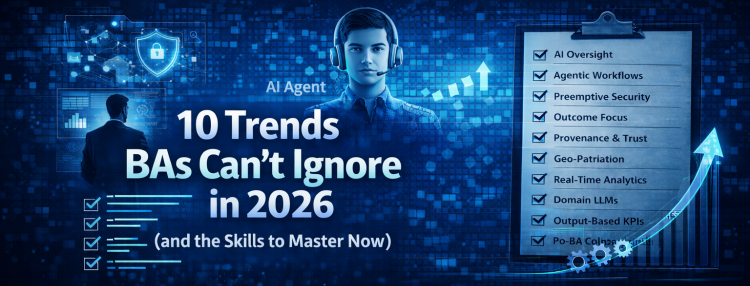
Multiple forecasts converge on the same practical reality: organizations are moving from experimenting with AI to operationalizing it—through agentic workflows, AI-native development, governance platforms, provenance, and security-by-design.
And when intelligence moves from assistance to action, Business Analysts become more—not less—important.
But only if our work evolves.
If your BA value proposition is “I write requirements faster,” automation will commoditize that.
If your BA value proposition is “I make complex change safe, measurable, and adoptable,” 2026 will reward you—because that is exactly what agentic systems and AI-native delivery demand.
This is a practitioner playbook for Business Analysts, Business Systems Analysts, Product Owners, and Product Managers who live inside software and technology projects—especially those solving real business problems under real constraints.
You’ll get:
- 10 shifts that will shape 2026 work
- 12 skills to build (and how to practice them)
- 15 concrete BA deliverables that teams will actually use
- Copy/paste templates you can deploy in January
The core idea: BAs are becoming “system stewards,” not scribes
The old mental model was linear:
discover → specify → build → test → ship
The 2026 model is cyclical:
discover → specify + guardrail → build → evaluate → monitor → adapt
What changes is where the BA creates value:
- not just translating needs into stories,
- but designing the system of decisions: what the system may do, what it must not do, how it proves itself, and how humans stay accountable.
That’s why the trends you’ll hear in 2026—multiagent systems, AI-native development, provenance, AI security platforms, governance—are not “tech trends.” They are requirements trends.
The 10 shifts that will reshape Business Analysis in 2026
Shift 1) Multiagent workflows move from pilots to production… in pieces
Gartner highlights Multiagent Systems as a strategic trend, reflecting systems built from multiple specialized agents coordinating to achieve goals.
Deloitte notes many organizations are testing agentic approaches, but production success depends on how work is designed and governed.
What it means for BAs: You’ll be asked to map workflows where “the system” is no longer a single deterministic app, but a set of semi-autonomous capabilities.
BA move: Define three things in every agentic workflow:
- decision rights (what the agent can do without approval),
- escalation triggers (when humans must review),
- evidence (what logs and explanations are required).
Shift 2) AI-native development compresses delivery cycles—so alignment debt grows faster
Gartner’s AI-Native Development Platforms trend points to tooling and practices that accelerate software creation with AI at the center.
Speed is great—until misunderstanding scales.
What it means for BAs: A small ambiguity can become a shipped feature before stakeholders even realize there was a decision to make.
BA move: Replace “documentation completeness” with “decision clarity”:
- problem statement
- constraints
- success measures
- agreed tradeoffs
Shift 3) Domain-specific language models turn domain knowledge into an asset
Gartner calls out Domain-Specific Language Models as a trend.
Organizations will increasingly build or tune models around domain vocabularies, policies, and rules.
What it means for BAs: Your domain modeling—glossaries, rule catalogs, exception lists—becomes leverage.
BA move: Treat the domain corpus as a product:
- ownership
- update cadence
- versioning
- governance
- testing
Shift 4) Digital provenance becomes a first-class requirement
Gartner elevates Digital Provenance, emphasizing the need to track origin and lineage of digital information.
And Gartner’s I&O trends include Disinformation Security—a signal that synthetic content and misleading information is becoming an operational risk.
What it means for BAs: Trust becomes a UX feature. Users will ask “why should I believe this?” not “how fast can I get it?”
BA move: Specify provenance UX:
- show sources when appropriate,
- show confidence/limitations,
- show “what changed” across versions.
Shift 5) AI governance platforms move into delivery flow
Gartner’s I&O trends include AI Governance Platforms.
PwC’s 2026 AI predictions also point toward responsibility and governance becoming practical, benchmarked, and operational rather than abstract.
What it means for BAs: Governance becomes a workflow you design, not a policy someone emails.
BA move: Define “governance as acceptance criteria”:
- approvals,
- evidence required,
- audit logs,
- review cadence,
- exception handling.
Shift 6) AI security platforms and preemptive cybersecurity become mainstream expectations
Gartner highlights AI Security Platforms and Preemptive Cybersecurity as strategic trends.
What it means for BAs: “Security by design” becomes “security in every story.”
BA move: Add AI-specific abuse cases:
- prompt injection,
- data leakage,
- unsafe automation,
- tool misuse,
- impersonation / synthetic artifacts.
Shift 7) Compute economics becomes part of requirements
Deloitte describes an “AI infrastructure reckoning,” where infrastructure choices, inference cost, and hybrid approaches become central.
AI features are not free: latency, cost, and accuracy tradeoffs show up fast.
What it means for BAs: You’ll need to specify constraints in business terms:
- “instant but approximate,”
- “slower but authoritative,”
- “human review required above threshold.”
BA move: Create a “service tier” requirement set:
- response time targets,
- cost ceilings,
- when to fall back to cheaper modes,
- when to escalate to humans.
Shift 8) Geopatriation and sovereignty reshape what “feasible” means
Gartner includes Geopatriation as a strategic trend and again in I&O 2026.
IBM IBV also emphasizes “localization” dynamics (“make it local”), reflecting regulatory and geopolitical realities shaping technology strategy.
What it means for BAs: Feasibility now includes geography:
- data residency,
- vendor restrictions,
- auditability,
- cross-border processing constraints.
BA move: Add a “jurisdiction checklist” early in discovery, before architecture hardens.
Shift 9) Physical AI expands software into operations and safety
Gartner’s Physical AI trend and Deloitte’s framing of AI going physical point toward more AI-driven capability embedded in real-world operations.
What it means for BAs: Requirements must include operational safety and exception handling:
- what happens when sensors are wrong,
- what happens when conditions change,
- what is the safe failure state.
BA move: Use failure-mode thinking (FMEA-style): identify unsafe states and define mitigations as requirements.
Shift 10) The workforce splits into AI generalists and decision owners
PwC predicts a rise of AI generalists and highlights skills needed to oversee and collaborate with AI systems.
IBM notes employees want AI tools that help them work and learn, implying adoption and enablement remain crucial.
What it means for BAs: Your edge isn’t “prompting.” It’s stewardship:
- aligning outcomes,
- ensuring accountability,
- supporting adoption,
- proving value.
BA move: Treat adoption as a product requirement:
- training,
- feedback loops,
- user support,
- success metrics.
The 12 skills Business Analysts should master in 2026
Think of these as “career insulation.” If you build these skills, you’re not competing with AI - you’re the person who makes it usable.
- Outcome-first analysis (metrics, baselines, targets)
- Agentic workflow design (human + agent + system handoffs)
- Decision-rights modeling (what can be automated, what needs review)
- Guardrails as requirements (allowed / not allowed, risk tiers)
- Evaluation design (benchmarks, acceptance tests for AI behavior)
- Monitoring and drift thinking (what changes, how you detect it)
- Provenance requirements (lineage, attribution, freshness)
- AI threat modeling (prompt injection, leakage, misuse)
- Governance-in-the-flow (evidence, approvals, audit)
- Cost/latency/accuracy tradeoff specification
- Domain modeling (rules, exceptions, vocabulary)
- Adoption engineering (enablement, comms, feedback loops)
The 15 BA deliverables that teams will actually use in 2026
If you’re tired of writing artifacts that no one reads, use this list. These deliverables survive contact with reality.
- Problem statement (one paragraph): who is impacted, what hurts, what outcome matters
- Decision log: what we decided, date, owner, rationale, alternatives
- Assumptions log: what we assume, risk if wrong, how we’ll validate
- Outcome metric plan: baseline, target, instrumentation, cadence
- Workflow map with exception lanes: happy path + top 5 exceptions
- Agentic workflow spec: decision rights, approvals, escalation triggers
- Guardrails catalog: forbidden behaviors, restricted data, safe defaults
- Risk tiering: low/medium/high risk actions and required controls
- Provenance requirements: allowed sources, freshness, attribution, conflicts
- Evaluation plan: what tests prove behavior, bias, reliability, and safety
- Monitoring plan: drift, anomaly thresholds, alerting, incident playbooks
- Rollback criteria: what triggers kill switch, who decides, how to revert
- Security abuse cases: prompt injection, leakage, impersonation, tool misuse
- Service tiers: latency/cost modes + rules for when to use them
- Adoption checklist: training, comms, support, feedback loop, success definition
If you have these 15 deliverables, you will be the person people call when “the AI thing” has to work in the real world.
Copy/paste: the Agentic Feature Spec
Use this as a template for any feature that uses agents, automations, or AI-generated decisions.
1) Business outcome
- Metric:
- Baseline:
- Target:
- Decision(s) we will enable:
2) Workflow scope
- Start / end:
- In scope:
- Out of scope:
3) Actors & decision rights
- Human roles:
- Agent roles:
- Agent can act without approval when:
- Human approval required when:
- Escalation triggers:
4) Guardrails
- Forbidden actions:
- Sensitive data rules:
- Compliance constraints:
5) Provenance & trust
- Allowed sources:
- Freshness rules:
- Conflict handling:
- Explanation UX (“why this?”):
6) Quality, cost, and safety
- Latency target:
- Cost ceiling:
- Reliability target:
- Confidence threshold:
- Safe failure state:
7) Evidence, monitoring, and rollback
- Evaluation method:
- Monitoring signals:
- Audit logs:
- Kill switch / rollback criteria:
A BA-friendly 30-60-90 day plan for 2026
| Timeframe |
Focus |
Actions (copy/paste) |
Deliverables |
| Days 1–30 |
Build “decision clarity” muscle |
- Start a Decision Log on your current initiative (what was decided, date, owner, rationale).
- Add one outcome metric with a baseline (what “better” looks like and where you are today).
- Map one workflow end-to-end including the happy path and top exceptions.
- Write three guardrails for the riskiest behavior (what must never happen).
|
Decision Log, Outcome Metric Baseline, Workflow Map (with exceptions), Initial Guardrails |
| Days 31–60 |
Make governance real (in the flow) |
- Define who approves what and what evidence is required (not just “security review”).
- Add an AI abuse-case set (prompt injection, data leakage, tool misuse, unsafe automation).
- Define monitoring signals and thresholds (drift, anomalies, performance/cost limits).
|
Governance Workflow (approvals + evidence), Abuse Cases, Monitoring Plan (signals + thresholds) |
| Days 61–90 |
Prove value and scale patterns |
- Ship a measurable improvement tied to your outcome metric.
- Run an outcome review with stakeholders (what changed, what didn’t, what we learned).
- Standardize 2–3 deliverables across the team (e.g., Decision Log, Guardrails, Evaluation/Monitoring).
|
Measured Release Results, Outcome Review Notes, Standardized Team Templates |
The viral conclusion (because it’s true)
In 2026, AI will write more text, generate more diagrams, and accelerate more code.
But it will not:
- align stakeholders,
- reconcile conflicting goals,
- define accountability,
- design safe workflows,
- specify what “good” looks like,
- and prove value after release.
That’s Business Analysis.
So the goal isn’t to become “the BA who uses AI.”
It’s to become the BA who makes AI operational—with outcomes, guardrails, governance, and proof.
 Author: Johnathan Mitchell, Enterprise Business Analyst
Johnathan Mitchell is a seasoned Enterprise Business Analyst with over 20 years of experience steering large-scale transformations and complex projects to success. With a keen eye for detail and a strategic mindset, he specializes in bridging the gap between business objectives and technological solutions. Johnathan has worked with Fortune 500 companies on projects across various industries, including finance, healthcare, and technology, helping them navigate the intricacies of enterprise-level initiatives.
His expertise lies in requirements engineering, process optimization, and stakeholder management. Johnathan is known for his ability to dissect complex business problems and devise innovative solutions that drive efficiency and growth.